AEROMEDIA
The Italian Aerospace Information Web
by Aeromedia - corso Giambone 46/18 - 10135 Torino (Italy)


Return to the Moon… and beyond

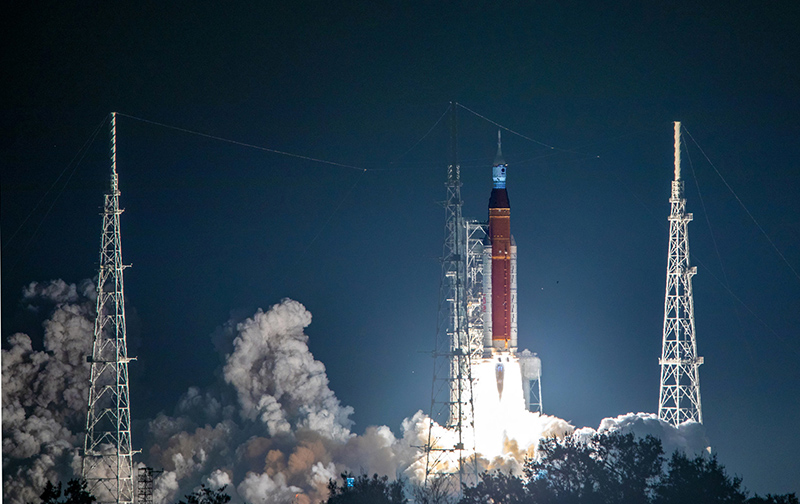
On November 16, 2022, after several attempts, the powerful SLS (Space Launch System) Block 1 rocket carrying the Orion spacecraft finally left Earth, headed for lunar orbit. This marked the beginning of the operational phase of NASA's Artemis programme, which will see humanity's return to our desolate satellite. For those unfamiliar with mythology, the goddess Artemis (Diana to the Romans) was the sister of the god Apollo. The programme's name was therefore not chosen by chance. But compared to the heroic "conquest" of the Moon half a century ago, which marked the United States' geopolitical triumph over the Soviet Union, the Artemis programme today pits "Western countries" against China's technological advances, financial capabilities and obvious space ambitions.
On several occasions, both Presidents Bush and Obama announced funding for NASA (later cancelled) for a return to the Moon. The Artemis programme waited for better times and has materialized with long-term planning that could extend all the way to Mars. But for now, before announcing reckless timelines, all parts of the spacecraft need to be tested while development continues on the components of the lunar orbital station and the infrastructure of the future "lunar village" capable of hosting a small human colony. This has been the ultimate dream of every science fiction fan.
For now, with the launch of the Artemis 1 mission, the efficiency of the Orion spacecraft's systems (this time manned by technological dummies) and the crucial European Service Module (ESM), which provides thrust and electrical power to the Orion Crew Module throughout the mission until reentry into Earth orbit, are being tested. As with other challenging space programmes, NASA will benefit from significant collaboration with the Italian Space Agency (ASI) through the European Space Agency (ESA), and with other international partners such as the Japan Aerospace eXploration Agency (JAXA) and the Canadian Space Agency (CSA).
Among the key players in the Artemis programme is Thales Alenia Space - a joint venture between Thales (67%) and Leonardo (33%) - which recently completed the supporting structure of Orion's European Service Module number 4, complete with the critical subsystems which ensure the life support and safety of the crew. It is currently in the clean room of prime contractor Airbus Defence and Space in Bremen, Germany. Integration will be completed and all final testing will be performed in Bremen. ESMs number 2 and 3 are already in the US, and the structure of the number 5 item is currently being assembled at Thales Alenia Space's facilities in Turin. NASA has entrusted ESA with the development of the ESMs for the Artemis missions. As a partner in the specific programme, the Nerviano site of Leonardo is supplying the photovoltaic panels (PVA) and power control and distribution units (PCDUs) for ESMs 1 through 6. NASA orders for subsequent ESMs will follow, through ESA.
Meanwhile, Thales Alenia Space is already actively considering the future of lunar exploration. It has initiated a series of studies to create a human-friendly ecosystem on our satellite. Leading a consortium of large companies, small-medium enterprises and startups, it will study sixteen projects for the Italian Space Agency related to long-term astronaut permanence on the Moon. These include fixed and mobile surface habitats, cargo carriers for lunar logistics, a "lunar power plant," and a "Lunar Science Laboratory."
The Franco-Italian company is also working on projects such as the "Lunar Shelter", the first pressurized outpost that will host astronauts on the surface of the satellite, the "multi-purpose" pressurized modules (MMP) for transport and logistics, the Cislunar Transfer Vehicle (CLTV) and the "European Lunar Lander" (EL3) Argonaut. These last two projects, developed under the aegis of ESA, are also aimed at supporting all the Artemis missions.
Looking further ahead, Thales Alenia Space is already working on the primary structure of HALO, NASA's habitation and logistics module developed for its US partner Northrop Grumman, being built in its factories. HALO will provide the initial living environment for the future permanent lunar orbital station "Lunar Gateway". The company is also the primary supplier of the I-HAB (International Habitat), the European astronaut home in lunar orbit, featuring a windowed module similar to the International Space Station's "Cupola", and the ESPRIT (European System Providing Refuelling, Infrastructure and Telecommunications) logistics module, two key elements that will shape the history of the return to the Moon and beyond.
Thanks to its recognized expertise, drawing on the experience gained with five Automated Transfer Vehicles (ATVs) and the construction of several other elements of the International Space Station (Nodes 2 and 3, Cupola, Columbus, MPLM & PMM, Cygnus PCM and Bishop Airlock), Thales Alenia Space is making a unique contribution to the achievement of what we can certainly call the reconquest of the Moon.
A list of all the Italian companies, large and small, and research institutes participating in varying degrees in the Artemis programme would be too long to include here. One of the most notable examples is Turin-based Argotec, which recently hit the headlines with the success of NASA's Dart mission. On September 26, 2022, during this unprecedented deep-space interception mission, the intelligent LICIACube microsatellite, produced by the Turin-based company, separated from its mother probe and photographed and then transmitted back to Earth, from 11 million kilometres away, exceptional images of Dart's impact with the asteroid Dimorphos. The name LICIACube comes from the abbreviation of Light Italian CubeSat for Imaging Asteroids.
On November 16, four hours after the launch of the SLS launch vehicle carrying Artemis 1 from Launch Complex 39B at the Kennedy Space Center, ArgoMoon - another Turin-made microsatellite - successfully separated from the rocket's second stage. Almost immediately, technicians at Argotec's Control Centre established communication with their adventurous creation (weighing 14 kg and measuring only 12 x 24 x 36 cm). Complex stabilization maneuvers followed, along with the first photographs of Earth from 125,000 kilometres away and the Moon from 278,500 kilometres away. ArgoMoon is equipped with two miniaturized cameras, one with a normal lens and the other with a telephoto lens.
During the Artemis 1 mission, the ArgoMoon microsatellite separated from Orion and took close up photos of the spacecraft until near the Moon and photographing our planet from various distances. Near the Moon, it fired its engines to avoid being sucked into a heliocentric orbit, going into a wide geocentric orbit. At this point, the second part of its mission began. This will last several months until ArgoMoon runs out of power. During this phase, it will collect telemetry data to validate onboard nanotechnologies in a hostile environment. Until now, the LICIACubes have been used on Earth observation missions from relatively low orbits, where the planet's magnetic field shields space radiation. LICIACubes have a hybrid propulsion system: a primary monopropellant for course changes and a secondary cold-gas propulsion system for orienting the photographic equipment in the absence of Earth's gravitational field. The question remains how all this equipment fits into such a tiny package. (Aeromedia)

In the picture: Cessna 172M Skyhawk II amphibian I-GNHR of the Aero Club Como (c/n 17264751 from 1974, ex C-GNHR until 2018) landing at Turin/Aeritalia Airport on 24 February 2026. (Aeromedia)

(Aeromedia, November 2022)